"All Scripture is inspired by God and profitable for teaching, for reproof, for correction, for training in righteousness; so that the man of God may be adequate, equipped for every good work." 2 Timothy 3:16-17
I love God, my husband was my high school sweet heart, and still is today. I’m a proud mother of the four most wonderful, sweetest, and cutest kids in the world! In addition, I am a mental health counselor. I love to write! I write from the most honest places within my heart and pray my experiences are able to help and encourage others on their journey through life.
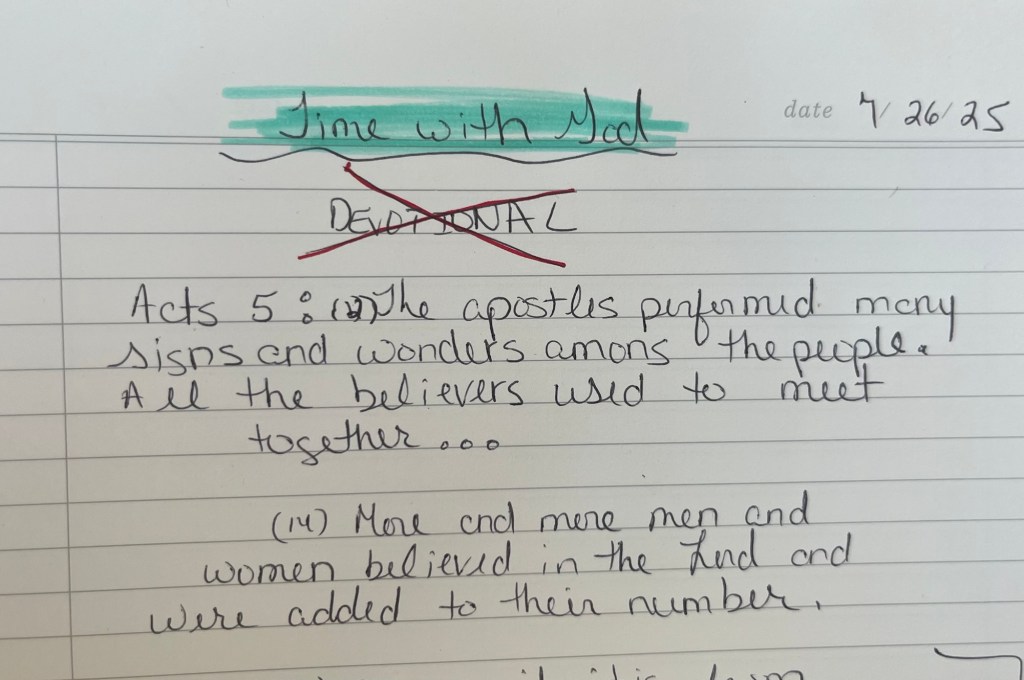
Sitting at the coffee shop this morning, I had a revelation regarding how I label my quiet time with God. I always write “Devotional” at the top of a blank sheet of paper. This is a way to engage more with the scripture, by writing verses that stand out, and thoughts that His word brings to my mind. There is nothing wrong with writing “devotional time” at the top of my paper, However I realized this morning, that it felt more like a phrase that feels dutiful and structured, like checking off a spiritual task. Making this one small shift in wording changed everything, at least for today.
I crossed out “Devotional” and above wrote “Time With God.” This felt inviting and refreshing. I mean who wouldn’t want to spend time with God?
As I sat down for my morning quiet time, there was an amazing and obvious shift happening within my spirit. I felt closer, wanted, invited, and a deeper desire to spend time with the Almighty Counselor, Comforter, and my Best Friend. Something powerful happened when I wrote the words “TIME WITH God”… Saying the words out loud feels like a breath of fresh air. Instead of crossing off a “spiritual task” or completing a chore, I was invited to sit with my Creator. I was reminded once again that spending time with God is a blessing and an honor. It is not an obligation; It’s an invitation.
“Time With God” is a time to sit with my Creator, my Shepherd, and my closest Friend. Time with God always draws my heart in, softens my spirit, and awakens a longing inside to be with Him.
Words matter. There is power of life and death spoken through words. This is why The Bible is life-changing and renewing – It is truly God’s words spoken to humanity.
Scripture reminds us of this truth over and over:
“The tongue has the power of life and death…” — Proverbs 18:21
“Let the words of my mouth and the meditation of my heart be acceptable in Your sight, O Lord…” — Psalm 19:14
“In the beginning was the Word…” — John 1:1
Words shape our mindset, our faith, and even our desire. This is the power of the most popular therapy tool, CBT, recognizing and altering the thought process to manage anxiety, depression, and fear. CBT being integrated with God’s word and the Holy Spirit is powerful and life changing.
Somehow this morning, renaming my devotional time to “Time With God,” made it all the more precious and special. Time with God should never be a task— God desires true relationship with me and you. That is amazing! We are loved by God! He longs to spend time with us! Time with god is not about checking a box—it’s about meeting with the One who holds my heart.
Perhaps today, you just need a small shift too…
Instead of saying “I have to do my devotional,” try, “I “get” to spend time with God.” WOW!
I pray this message breathes fresh life into your day, in the same way it did mine!
It’s going to be a good day! I started it with “Time With God”!
As a counselor, one concern I hear often is whether virtual therapy is as effective as in person therapy.
Common Questions:
1. Are you able to thoroughly connect with a therapist through a virtual platform?
2. Do you lose personal connection through a screen?
3. Is virtual therapy as effective as in-person therapy?
I have been wanting to address this concern professionally for quite sometime. Here are my thoughts, with evidence based proof on the subject.
In our digital age, people question whether a true therapeutic connection can be established through the medium of a screen or telephone. This is a valid concern, as the “relationship” between client and therapist is the essential ingredient to healing outcomes. Every well trained and effective therapist’s primary concern should always be about building rapport, portraying authentic empathy, and establishing trust with clients. Can these essential aspects of therapy be established in a virtual setting?
I have been an in person therapist and a virtual therapist for nearly 10 years: What I have learned from providing both forms of therapy consistently is that it truly doesn’t make a difference in the quality of therapy or the outcomes of therapy. The most important aspect is whether the therapist can build rapport and establish trust with a client, an effective therapist will be able to do this regardless of the manner of connection. From a Christian perspective, healing is a holistic journey of the mind, body, and spirit. A compassionate and skilled therapist is as powerful in a virtual room as in the office. A Christ-like presence transcends physical boundaries and offers hope, understanding, and grace no matter the format. Many people insist on in-person therapy, which is totally understandable and completely up to the client to make the best decision for them. I will say, this often limits them to lower quality of care, less variety, and can be more costly due to the overhead costs for the clinician.
⸻
1. Evidence from Empirically Proven Studies
• Studies have proven no measurable difference in therapeutic outcomes. A 2022 meta-analysis of 12 randomized controlled trials (931 clients) across conditions—addictions, eating disorders, childhood mental health—found no significant differences between telehealth and face-to-face therapy in symptom reduction, overall improvement, functioning, client–therapist working alliance, or satisfaction—both immediately and in follow-up (Remnant Counselor Collective, NIH Study).
• Broad meta-analytic support. A larger meta-analysis including 20 trials reported no significant difference in treatment outcomes post‑treatment (g = –0.043) or at follow-up (g = –0.045), and attrition rates were virtually identical (RR ≈1.006) (ResearchGate).
• CBT efficacy holds firm. Studies confirm that therapist-guided remote Cognitive Behavioral Therapy (CBT)—via phone or video—is as effective as traditional CBT for many disorders.
• Even audio-only therapy works. Research supports that telephone-based therapy for depression and anxiety is just as effective and builds strong therapeutic alliance.
⸻
2. A Christ-Centered Connection, Even Online
For Christian’s, building rapport is not about physical presence; it’s about presence of heart; it’s about whether the therapist connects with the Holy Spirit and their ability to allow Christ to be an active participant in all therapy sessions. When a therapist listens with empathy and responds with wisdom and compassion, the love of Christ is made known—even through a screen. It is Christ in the center of the session, actively working within hearts, the therapist and the clients that aid in deep rooted healing.
Many clients feel more at ease in their own space, and therapists gain valuable context by glimpsing a client’s home environment. For many, virtual therapy feels less intimidating and more intimate.
2 Corinthians 13:11 “Finally, brothers and sisters, rejoice! Strive for full restoration, encourage one another, be of one mind, live in peace. And the God of love and peace be with you.”
Philippians 2:2 “then make my joy complete by being like-minded, having the same love, being on in spirit and of one mind.”
⸻
3. When Virtual May Not Be Ideal
While virtual therapy is highly effective for most people, there are a few potential exceptions:
• Young children and some teens may have difficulty staying focused in virtual sessions. They often benefit more from in-person engagement where play, movement are more easily achieved.
• Easily distracted clients—especially those with attention challenges or chaotic home environments—may struggle with consistent engagement online.
* Domestic violence situations where speaking freely is unsafe.
Steps For Setting Up an Environment for Effective Virtual Therapy
• Find a quiet, private space with minimal distractions.
• Silence notifications, close other tabs or devices, and treat the session with the same priority as an in-person visit.
• Avoid being preoccupied with work, multitasking, or checking your phone. Making space for therapy reflects your commitment to healing—and to honoring what God is doing in your life through this process.
⸻
4. Practical and Spiritual Benefits of Virtual Therapy
• Accessibility: Virtual sessions break down barriers—geographic, financial, and physical—opening the door for more people to receive care.
• Comfort and control: Being in your own home often reduces anxiety, fosters safety, and encourages openness.
• Efficient stewardship: Time saved from commuting can be invested in prayer, rest, or further spiritual growth.
⸻
Conclusion
The research regarding the effectiveness of virtual therapy is solid and shows that it is just as effective as in-person therapy for the majority of the population. With proper preparation and a heart open to God’s healing work, virtual therapy becomes more than just convenient—it becomes sacred space. In fact, in many ways I have seen it prove to be even more effective, as people feel more comfortable in their own settings.
As Christian therapists, we believe that the Holy Spirit is not bound by physical walls. He meets us in the counseling room, the car, or the corner of a quiet bedroom where someone logs into their session. Whether in the office, online or over telephone, what truly matters is the relationship—a space where trust is built, healing begins, and lives are transformed by grace. I am grateful for my clients who allow me the opportunity to do what I love everyday, being a part of God’s healing journey for their lives.
I am grateful for the amazing virtual therapists who have walked with me through some of life’s greatest struggles. I am grateful that I am not limited by a defined number of therapists located in a single town, but due to present day technology have access to a larger therapist network by having access to anyone licensed in the state where I reside.
I pray this article acts as a guide for those of you questioning the effectiveness of virtual therapy verses in-person. Regardless, of the choice you make it is important to pray and seek God for guidance to find a therapist who can help you healing by connecting with you and helping you to connect with the True Almighty Counselor.
As a counselor and a follower of Christ, I’ve been deeply grieved by the level of tension and hostility in our country. This tension has been building for many years and there is no longer a sense of unity as “Americans”. The political landscape in this country is no longer about opposing views and differing opinions, it is a blatant and obvious battlefield — not of ideas, but of people. Neighbor against neighbor. Friend against friend. Family member against family member. American against American. Let this sink in —— This is the epitome of heart breaking.
Let’s be honest — the enemy is having a field day. The sad part is that he’s using you and me to do his dirty work and we’re buying into it. We’re failing to recognize the enemy’s schemes and it’s destroying us from within. Our greatest enemy isn’t China, Russia, or North Korea, it is the political playing field right here in our wonderful U.S.A. We are no longer unified on one single thing… Wake up America before it’s too late to be redeemed. There Is no single political party or leader to blame… We’re all to blame. The hate spewed on every news channel, newspaper, social media site, is outrageous. We buy into it blindly and the hate literally spreads like wildfires; Hate in our nation, work places, schools, communities, churches, and even within our own families.
The Bible states in Ephesians 6:12,
“For our struggle is not against flesh and blood, but against the rulers, against the authorities, against the powers of this dark world and against the spiritual forces of evil in the heavenly realms.”
Friends, Satan is the author of division. Not the republicans, the democrats, or the independents. Not your boss, friend, co-worker, neighbor, and especially not your family members Satan is this world’s greatest enemy and He thrives in chaos. The political culture right now, is one of his sharpest tools. The enemy is literallly having the time of his life and is loving the hate and tension he’s creating.
Time for American’s to unite as American’s! Time to stop fighting against each other and see the spirtual battle running rampant in this country. Time to stop pointing fingers and begin listening. Time to pray rather than spew misinformation, anger, and lies. Time to recognize that all political parties have one goal to win… And they’re not looking out for anyone but themselves. Time to wake up and see the battle for what it is… An attmept to stir hate and division.
Each of the political parties have a goal to drive a wedge between us, to stir up fear, anger, and pride. The goal isn’t simply disagreement — it’s disunity. And it’s working.
I want to say again;
I am not a Republican. I am not a Democrat.
I am a Christian.
And…
I am an American.
My allegiance is first and foremost to Christ. As a Christ follower my calling is to love — not to hate, attack, or divide. I will no longer trust the antics of any party that thrives on stirring hatred and demonizing those who disagree. When our leaders fuel rage for personal or political gain, we must call it what it is: manipulation, evilness, and darkness.
We were never meant to find our hope in elephants or donkeys. Our hope is only to be in “The Lion & The Lamb”.
I believe it’s time for the body of Christ to rise above the noise. To stop parroting party lines and start living by God’s truth. To see people, as people; not just as poltical foes or friends. To speak life, not venom. To engage with humility, not hostility.
This isn’t about avoiding hard conversations or pretending we all agree. It’s about refusing to let the enemy steal our unity through political division.
Somewhere along the way I got lost. Despite the obvious signs, I failed to notice I was veering away from the intended target. Taking entirely wrong routes and failing to stop at necessary stops along the way, I grew tired and emotionally fatigued. By the time I recognized how far I’d deviated from the course, away from my desired destination, it was too late to turn around. I wanted so badly to turn around, to start where I first began wandering away, but I couldn’t! In all honesty, I didn’t even know where I took that first wrong turn. Sitting on a long narrow path, afraid I would never make it back, tears began to flow in droves down my checks. I yearned with everything in me for the comfort and peace of God’s heavenly sanctuary! Looking around I saw the scenery, it was wild and out of control. Despite my efforts, it seemed impossible to get my bearings together! To get back on the right track. The fear, the hurt, and the anger screamed out from the depths of my spirit. “How can I find my way out of this mess? How can I find my way back home?” Sobs overcame my spirit, as the past slowly came back to me. The wrong turns, poor choices, and the continual failure to ask the Lord for directions and guidance. Suddenly I knew where to turn, I looked up into the face of Jesus! Looked full in his wonderful face, as the confusion of my lost and weary soul began to connect with God. All of a sudden I was broken, sobbing, and in complete surrender to the Heavenly Father! I was broken, but no longer plagued with a heavy sense of dread. No longer did I feel lost and alone! The world and it’s problems began to fade away! Suddenly, the narrow road before me opened up and I saw a light. My weary heart felt a new hope! Somewhere along the way, I took my eyes off Jesus and got lost! Feeling stranded and alone I headed down a road of emptiness, pain, and rejection. My focus grew hazy as the road to worldly pleasures became vividly clear. I stopped in the middle of that dark
and empty road all alone! Mesmerized by the light before me, the only place to look was up. My heart immediately felt peace! I was back on track and headed home. Into the arms of Jesus!
The process of knowing the truth about {you} Is essential to becoming Christ-like. We can not become more like Christ when we are operating in denial about our pain, insecurities, trauma, weaknesses, sinful bents, and behavioral addictions. Through this process we learn to understand God more; his unconditional love, faithfulness, tenderness, forgiveness,
and gentleness.
For this reason, it is essential to take responsibility for owning your emotions. As a counselor, I know that I cannot help my clients to heal by managing their emotions for them. I am not able to wave a magic wand and make their lives great and wonderful, I wish I could. I am able to sit with them, point them to Jesus, comfort them, challenge them, and teach them healthy coping skills for the management of their emotions. One thing ive learned with absolute confidence, is that no one else can carry the weight of another’s inner life; I’ve learned this the hard way {literally} by trying my hardest to save those I love. This process only created anxiety, hurt, and a greater division in the relationship.
A common theme we’ve all experienced and all have been quilty of at some point, is blaming others for mistakes or unhealed pain. Often, we humans suppress how we feel. This may seem easier in the moment, but it keeps us from growth, healing, and deeper intimacy with God.
When we go through the process of owning our emotions through a spiritual journey, we begin a holy and sacred process. This is the first thing I discuss with new clients, “We are beginning a spiritual journey of healing.” Friends, emotions are not the enemy—they’re messengers. They offer insight into our heart, soul, and body: emotions tell us what we fear, what we value, where we’re wounded, and where God is inviting us to grow. Owning our emotions teaches us about ourselves—our strengths, our struggles, and our hidden hurts.
Friends, the more we learn about ourselves, the more space we give God to transform us. Self-awareness isn’t prideful, arrogant, or a weakness; It is an essential process to becoming more Christ-like. It is absolutely essential to being an emotionally safe person. Personal self-reflection and increased insight is the primary tool the Holy Spirit uses to refine us, comfort us, and align our hearts with God’s truth.
In God’s word, the Psalmist cried out with “honest”, with real emotions and feelings. He allowed the process to point to Jesus. In scripture, Jesus wept, experienced fear over the crucifixion., and pain over loss. The process of owning emotions is modeled in the scripture. Emotion is the process of bringing into the light our whole self; so that healing can begin. By learning to manage emotions with love and compassion, we move towards becoming more like Christ. Through the process we find peace with ourselves, our pasts, those who’ve hurt us, and with God.
I say this in love and with great compassion, take responsibility for your emotions. Allow them be the gateway, not a barrier, to good emotional and spiritual health. Allow your emotions to be a profound teacher, pointing you to Jesus for understanding, wisdom, and healing. Through this process of emotional ownership, if you seek Him, God will meet you on the journey. Together, you’ll find your way to God, healing, peace, mended relationships, and abundant joy on the path to a victorious life in Christ.
“Search me, O God, and know my heart; test me and know my anxious thoughts.” — Psalm 139:23
🌎 Anxiety Tip: Make a habit daily of intentionally focusing on the beautiful, good, and positive aspects of life.
The brain was created “literally” to keep you safe. Therefore, its job is to continually scan the environment for any signs of danger. The more in depth traumatic experiences we have in life, the more the brain is wired to be hyper- vigilant. This hyper-vigilance Is often instilled within us as children and it takes intentional efforts to rewire the brain towards safety and peace. This trauma response can also show up in our adult life after significant traumatic experiences; Car accidents, assaults, loss of significant others, or any exteme difficult life experiences.
Regardless, the cause of the traumatic incidents, the cure is the same. Retraining the brain to feel safe. Intentionally seeking the good in our world’s is the first way to help rewire and heal a traumatized brain.
🌺 Steps to Overcoming Trauma and Anxiety.
Look around you today for beauty; It is everywhere when you intentionally begin to see God.
Recognize the thoughts that run on autopilot in the back of your mind.
Build awareness of your thoughts and take them captive by writing them on paper.
Look for beauty, practice gratitude, and learn to recgnize the presence of God in your life.
Watching the sunrise is a wonderful way to intentionally seek beauty. This will never get old.
God’s word is a wonderful guide for how to manage anxiety.
Philippians 4:8 & 9…
“Finally, brothers and sisters, whatever is true, whatever is noble, whatever is right, whatever is pure, whatever is lovely, whatever is admirable-if anything is excellent or praiseworthy-think about such things. Whatever you have learned or received or heard from me, or seen in me-put it into practice. And the God of peace will be with you.”
Happy healing through the art of learning to enjoy the world we live and worship God in.
As a counselor, one of the most concerning and heart-breaking issues facing our nation, is adult-child and parent estrangement. I have seen in my office first hand the intense pain caused by estrangement. I’ve witnessed and counseled parents and adult-children, who’ve been impacted by this cultural trend.
In our increasingly divided culture, estrangement receives little focus and attention. Estrangement is a painful separation occurring in families, where adult-children and parents no longer communicate. The estrangement between parents and adult- children is on the rise, it has become a common and has become a trend. In Christian families, this separation brings not only emotional pain but deep spiritual grief.
The Pain of the Parent
For many parents, the silence of a son or daughter who no longer calls, writes, or shows up is more painful than anything they’ve ever endured. It’s especially painful when the adult-child cuts off complete and total communication. This causes a sense of grief that seems consistent with the loss that comes with the death of a child. In some ways, it seems worse because the parent knows their child is living, but they’re completely cut-off, instilling deep rejection and intense pain. In this scenario, the parent is unable to fully grieve and unable to move toward healing, they feel stuck. They feel stuck, between the constant longing of reunification and the hopelessness of the adult-child’s determination to remain silent and cut off. These parents feel stuck, because in this situation they often are stuck. These parent is completely unable to communicate and their left feeling completely powerless. Parents are filled with sorrow, confusion, guilt, and shame. Continually asking themselves, “Where did I go wrong?” This is a question that echoes inside of them endlessly. The parental heart, was designed by God to nurture and guide, and estrangement leaves them aching and feeling a deep void.
Parents often replay memories of their children over and over, with no hope of making new memories in the present or future. It feels to them like memories are all they have and they replay them in their minds over and over. These parent’s feel alone, as the grief is often hidden because few understand their pain, they may feel embarrassed, and struggle to share their experience. In addition, there are limited resources to help them process and endure their pain. Estrangement is painful, it is important to remember that there is hope.
The Perspective of the Adult Child
Adult children oftentimes have real hurt, pain, trauma, and brokenness that causes them to make the decision to cutoff communication with their parent(s). It is important to remember the adult-child’s decision to cut off the relationship is not easy and is certainly not without great pain. In addition, the decision to cut off communication is usually not made in haste. The decision is most often arrived upon after years of enduring dysfunctional patterns of emotional neglect, feeling controlled, years of manipulation, abuse (physical, mental, sexual, or spiritual), and years of feeling unheard / unseen. Adult children are finally learning to name the trauma they experienced in their family of origin—sometimes subtle, sometimes severe. They most often lack the understanding of how to manage painful parent relationships and as a result, feel the only choice they have is to cut off communication.
The current culture of “cutting off toxicity” encourages adult children to sever ties as a form of self-protection and empowerment. Unfortunately, while it may provide immediate relief, it can also bypass the hard, redemptive work of healing and boundary-setting within the relationship. This is heartbreaking because it leaves the adult-child, the parents, grandchildren, and the relationship in a perpetually broken and unhealed state. It is true, in some severe cases estrangement might be the only safe option. All too often, it is chosen prematurely, without deep discussions, attempts at redefining the relationship, learning to set healthy boundaries, or attempts at reconciliation.
The Cultural Climate
There is a growing cultural message that says, “If someone—even your parent—hurts you, cut them out of your life. This is a tragic tool of the enemy that rips family’s apart and causes tremendous pain to adult-children and their parent(s). The Christian response is not to cancel people out of your life but to begin with confronting in love, seek understanding, and pursuing healing when possible (Matthew 18:15-17, Romans 12:18).
The healthy response to adult-children and parent struggles is rarely complete estrangement. Instead, God invites us into the hard work of honest conversations, learning to implement healthy boundaries, forgiveness, and even therapy. If these tools prove to be ineffective, temporary estrangement should be considered first, as a firm boundary. Followed by firmer boundaries, such as complete estrangement if abuse persues. It is important to know that God can redeem what is broken.
When Estrangement is Necessary
There are cases, when estrangement is the only option. In situations of ongoing emotional, physical, or sexual abuse, the safest and healthiest decision may be distance. God never asks His children to remain in relationships where they are being abused. Psalm 34:18 reminds us, “The Lord is close to the brokenhearted and saves those who are crushed in spirit.”
After the adult-child has made attempts at healthy repair in love, if the parent(s) persists in causing harm, then estrangement may be the only option. When a parent refuses to change and fails to acknowledge harm, or if an adult child is unsafe (emotionally, physically, or spiritually); Stepping away from the relationship may be the necessary boundary. At times, this firm boundary may be the avenue to healing, as the parent is forced with the decision to make healthy changes or forfeit the relationship with their adult-child. In extreme cases when estrangement is the only option, it is important to remember that healing can still happen with God, but the relational restoration may not be possible on this side of eternity.
A Call to Healing
Parents
If you find yourself in this painful situation, pray, grieve, repent if needed, and release your child to God. It is important to remember in your distress to not succumb to the dysfunctional tactics that most-likely caused your child to halt communication. Never push your child to reconcile, do not use manipulative techniques in an attempt to control them, and never use shame as a means of guilting them into coming back. Always portray unconditional love, own the pain your behavior caused, and ensure they know that your door—and your heart— is there upon their return.
Most importantly, ask the Lord to grow you in this season. Use this pain-filled season to work on becoming the healthiest version of yourself. Dive into God’s word, pray without ceasing, get involved in Bible studies, seek out a wise Christian counselor, and talk to spiritually wise mentors. This time of estrangement should not be wasted growing bitterness and resentment, or thinking you’re right and they’re wrong. This is a sure way to ensure your child stays away for a very long time. It is time to learn new communication skills, life skills, healthy relationship skills, and grow in your faith.
Adult-children
This is a time for you to seek healing, not just distance. I know for a fact that distance itself will not resolve the pain you’re experiencing. In fact, it can lengthen the pain you’re experiencing and can cause regrets if you’re choosing to walk away because just because it’s easier. Ask yourself: Am I seeking true peace, or just silence? Have I attempted to learn healthy ways of relating to, setting boundaries, and redefining the relationship? , If at all possible, avoid the extremes of total cutoff if the relationship is merely strained, not unsafe.
Special note: I am sorry for the pain you’ve endured. I know firsthand the pain that comes from abusive / neglectful parents. I know the void it leaves in your heart. I’ve lived through this pain for many years. The process of redefining the relationship in Christ, rather than walking away in total estrangement has allowed me to live in peace and has left me with no regrets on the other side. Know the Lord is your Father and He will carry you and guide you through the process. The Lord has used this tremendously painful trial my life to teach me many wonderful life lessons, to strengthen my resolve and grow my confidence. Your pain is not in vain when the Lord is your guide. Be sure the Lord is guiding you and never the enemy who comes to steal, kill, and destroy.
Hope in Christ
Jesus understands estrangement—He knows the pain you feel and he empathizes with us in our most painful life trials. He was betrayed, misunderstood, disowned, and crucified. Jesus, knows the impact of abuse and He cares about your heart. His life was marked by compassion, truth, and an unrelenting pursuit of reconciliation. That is our model too. Let, it be your model for processing and working through the pain caused to you by everyone, especially your parent(s).
Remember, there is hope. God is a restorer of the brokenhearted, a reconciler of families, and a redeemer of our most painful stories. God created the family and his heart rejoices when parents and children find unity and healing. Sadly, not every relationship can be healed—but remember this… every heart can be. Keep praying. Keep growing. Keep hoping.
“All this is from God, who through Christ reconciled us to Himself and gave us the ministry of reconciliation.” – 2 Corinthians 5:18
In the midst of distressing circumstances, our bodies often send us messages that are hard to ignore – tightness in the chest, shallow breathing, rapid heartbeat, and racing thoughts. These symptoms are the bodies attempt to protect us in potentially threatening situations. God has instilled within all creatures, humans included, a “fantastic” alarm system. Its purpose is to keep us safe and free from threat. Trauma is quite common and to many of us, these sensations are not new. These triggers are echoes – alarms in the present attempting to guard us against past traumatic events.
Good Christian therapy consists of learning to recognize the sensations and thoughts we experience in everyday life. While learning to recognize that these symptoms are often rooted in past experiences. The “uncomfortable” trauma triggers we experience, are protective cues informing us that our bodies and souls have been here before.
You may find yourself in a situation where you’re afraid to set a boundary, afraid to say no, or to disappoint someone. You feel that heavy knot in your stomach or that flutter of anxiety in your chest. Why is it so hard to speak up? To protect your peace?
When we explore these feelings honestly and prayerfully, we often discover that they are rooted in fear—not just fear of rejection, but fear of punishment, emotional manipulation, or even physical harm. Perhaps in the past, choosing to set a boundary led to an outburst from someone you loved, or silence that lasted for days. Maybe standing your ground once brought consequences that left lasting emotional scars. The trauma wasn’t always dramatic or obvious—but it was real.
Trauma can disguise itself as people-pleasing, over-apologizing, or complete emotional shutdown. These behaviors are attempts to stay safe, to avoid the pain we’ve known before. But God has not called us to live in fear. As 2 Timothy 1:7 reminds us, “For God has not given us a spirit of fear, but of power and of love and of a sound mind.”
Recognizing this fear is the first step. Feeling it and tracing it back to its source is where healing begins. Christian trauma therapy helps us do just that—gently, safely, and prayerfully. In the presence of Christ, we are invited to bring our wounds into the light, not to be shamed or minimized, but to be healed.
Through skilled Christian counseling, individuals can begin to understand how past wounds are affecting current relationships and decisions. They can learn to listen to their bodies, honor their emotions, and find their voice again. They can begin to believe that God desires healing for the whole person—body, mind, and spirit.
If you find yourself stuck in patterns of fear or distress, especially when trying to do what’s right and set healthy boundaries, know that you are not alone. And you are not broken beyond repair. With God’s help and the support of trauma-informed Christian therapy, you can begin the journey toward freedom. You can rewrite the story—not by erasing the past, but by letting God redeem it.
You were made for peace, for wholeness, for love without fear. And healing is possible.
Practical Tools for Recognizing and Healing from Trauma
1. Body Check-Ins
Set a timer once or twice a day to pause and ask:
• What am I feeling physically right now?
• Where do I feel tension or tightness?
• What emotion might be connected to this physical sensation?
2. Boundary Reflection Journal
After a difficult conversation or situation, journal these questions:
• Did I feel free to speak truthfully?
• What was I afraid would happen if I didn’t comply?
• Have I felt this fear before? When?
3. Safe Space Visualization
In prayer, imagine a safe place with Jesus in it. Picture Him looking at you with compassion. Ask Him:
• “Lord, what do You want me to know about this fear?”
• “Where were You in my past pain?”
Let your spirit rest in His presence.
4. Affirmations Rooted in Truth
Write down and repeat affirmations like:
• “I am not alone. God is with me.” (Isaiah 41:10)
• “My voice matters. I am loved, even when I set boundaries.”
• “I am safe to heal. Christ is my refuge.” (Psalm 46:1)
5. Christian Counseling
Seek a trauma-informed Christian therapist who understands the deep integration of faith and emotional healing. You don’t have to navigate this journey alone.
⸻
Scripture-Based Reflection Prompts
Use these verses in your quiet time to guide healing and prayer:
• Psalm 34:18
“The Lord is close to the brokenhearted and saves those who are crushed in spirit.”
→ Lord, where do I feel brokenhearted today? How can I invite You into that space?
• Isaiah 43:2
“When you pass through the waters, I will be with you…”
→ Jesus, what waters have I been passing through? Help me feel Your nearness.
• Romans 12:2
“Do not conform to the pattern of this world, but be transformed by the renewing of your mind.”
→ Lord, what patterns am I stuck in that You want to renew? Show me the truth.
• John 10:10
“I have come that they may have life, and have it to the full.”
→ God, what does fullness of life look like for me as I heal?
⸻
You are not alone, and you are deeply loved. The God who sees every wound also holds the power to heal. In Him, there is safety. In Him, there is rest. In Him, there is transformation.
Have you ever had someone say or do something that caused swift and deep pain, often times causing overwhelming physical body sensations. When someone treats you poorly, or you’re suddenly thrust into a moment that echoes painful circumstances from your past, your body often knows it before your mind is aware. You might feel tightness in your chest, your hands may tremble, your stomach may churn—or maybe your left feeling numb and frozen. These are somatic trauma responses, and they are your body’s way of saying: “Something feels unsafe.”
✨ What Are Somatic Trauma Responses?
Somatic responses are physical reactions to emotional wounds. If you’ve lived through trauma, your body carries these memories in it’s core. The body keeps the score. The body’s memory when you’re triggered willl send immediate survival hormones to alert you for self-preservation and survival. This is often caused —by a harsh word, rejection, anger, certain sounds and smells, or even a familiar tone. Your nervous system when threatened will kick into survival mode: fight, flight, freeze, or fawn.
Many people feel and are often told this is some type of weakness. Absolutely not: It’s your body trying to protect you. It’s biology. In fact, it is the way God made each one of his children and all His creation.
🙏 God Cares About Your Whole Being—Body, Mind, and Spirit
Psalm 34:18 says, “The Lord is close to the brokenhearted and saves those who are crushed in spirit.”
God doesn’t just care about your soul—He cares about your entire being, including the body where trauma still lingers.
🌱 How Can You Manage These Symptoms?
Gentle Internal Questioning When your body reacts, pause and ask: • What am I feeling in my body right now? • When have I felt this before? • What might my body be trying to tell me?
Ask with curiosity, not judgment. There is now no condemnation to those in Christ. God invites us into truth, and truth begins with awareness. “The truth will set us free.”
Grounding in Prayer Use breath prayer to anchor you: • Inhale Slowly: “The presence of Jesus.” • Exhale Slowly: “Calm my soul and body”
Pray God’s word.
A good verse – Psalm 46:1—“God is our refuge and strength, an ever-present help in trouble.”
Prayer is not just asking God for things; it’s abiding in Him, feeling His presence with you all the time. Especially, when your nervous system is triggered.
Mindfulness Techniques with Faith at the Center • 5-4-3-2-1 technique: Name 5 things you can see, 4 you can touch, 3 you can hear, 2 you can smell, and 1 you can taste. (It works… TRY IT!) • Place your hand on your heart and breathe deeply. Imagine Jesus laying His hand over yours. • Visualize a safe space with God—perhaps a quiet garden, the beach, in the mountains, a grandma’s couch, or beside still waters (Psalm 23).
Affirm Your Identity in Christ
Trauma can make us feel powerless, but 2 Timothy 1:7 reminds us: “For God gave us a spirit not of fear but of power and love and self-control.”
Whisper truth to your heart: “I am safe. I am okay. I am loved. I am not alone. I am healing.”
🌷 Final Encouragement
Healing takes time, it’s a journey, not a destination. Everyone has somatic responses on some level, it doesn’t mean you’re broken— it means you’re surviving. Let your trauma responses become signals, not shameful verdicts. In fact, shame halts healing. Remember, God understands your pain. He knows the exact cause or our triggers and why our nervous system is heightened. He sees every racing heartbeat and every tear. He seems the one who caused your the pain – He is an aware God. He holds space for your healing, patiently and faithfully.
Pause when you find yourself in this triggered and uncomfortable place; Ask God to reveal the reason for your symptoms. He will!
Important: Always be kind to your body. Be honest with yourself. Invite God into the process—He’s already there, waiting with open arms.
⸻
🤗 If you found this helpful, feel free to share or save it for the next time your body needs a gentle reminder: You are not alone. You are not crazy. You are healing—with God, moment by moment.
When the night feels long and hope runs thin. When fear is knocking, wanting in. I will lift my eyes, I will speak His name. Jesus, you’re my shelter in the wind and rain.
Because of Jesus, I won’t be shaken. He Is my fortress, I won’t be moved.
God’s Word points me to truth. God’s word leads me to hope. God’s word guides me to the light.
I will not be anxious, I will not fear. In every moment, Jesus is near. In times of distress, He’s the Almighty Counselor. With prayer and praise, I will lift my hands. Thank you, Jesus, for catching me when I fall. Your peace is deep like the ocean. Your love flows like a river. You always answer when I call.
Jesus, guard my heart, from the forces of evil. Your love is my fortress. Your love is my protector. Your love is my shield. I know, your peace surpasses all. In Jesus’ name, I praise you!
Troubles will come, like the waves crashing into the shore. I will not fear, for I know you are near. I won’t run, I know you’re by my side. With calm assurance, I will abide. In grateful prayer, lifted to your throne. I find release from my troubles. I’ll gladly trade this world’s chaos for the peace that surpasses all..
I have no need for worry, there’s no need for anxiety. Jesus, you hold everything together and you’re the breath of life.
I will not be anxious, I will not fear. In every moment, Jesus is near. In times of distress, He’s the Almighty Counselor. With prayer and praise, I will lift my hands. Thank you, Jesus, for catching me when I fall. Your peace is deep like the ocean. Your love flows like a river. You always answer when I call.
Unconditional peace this world can’t provide. Jesus your peace comes from grace and mercy, in which I’ll abide. Perfect peace keeps my heart and calms my mind. Jesus, thank you! You are perfect and kind.
Philippians 4:6-7 “Do not be anxious about anything, but in every situation, by prayer and petition, with thanksgiving, present your requests to God. And the peace of God, which transcends all understanding, will guard your hearts and your minds in Christ Jesus.”









 The Flame Within